
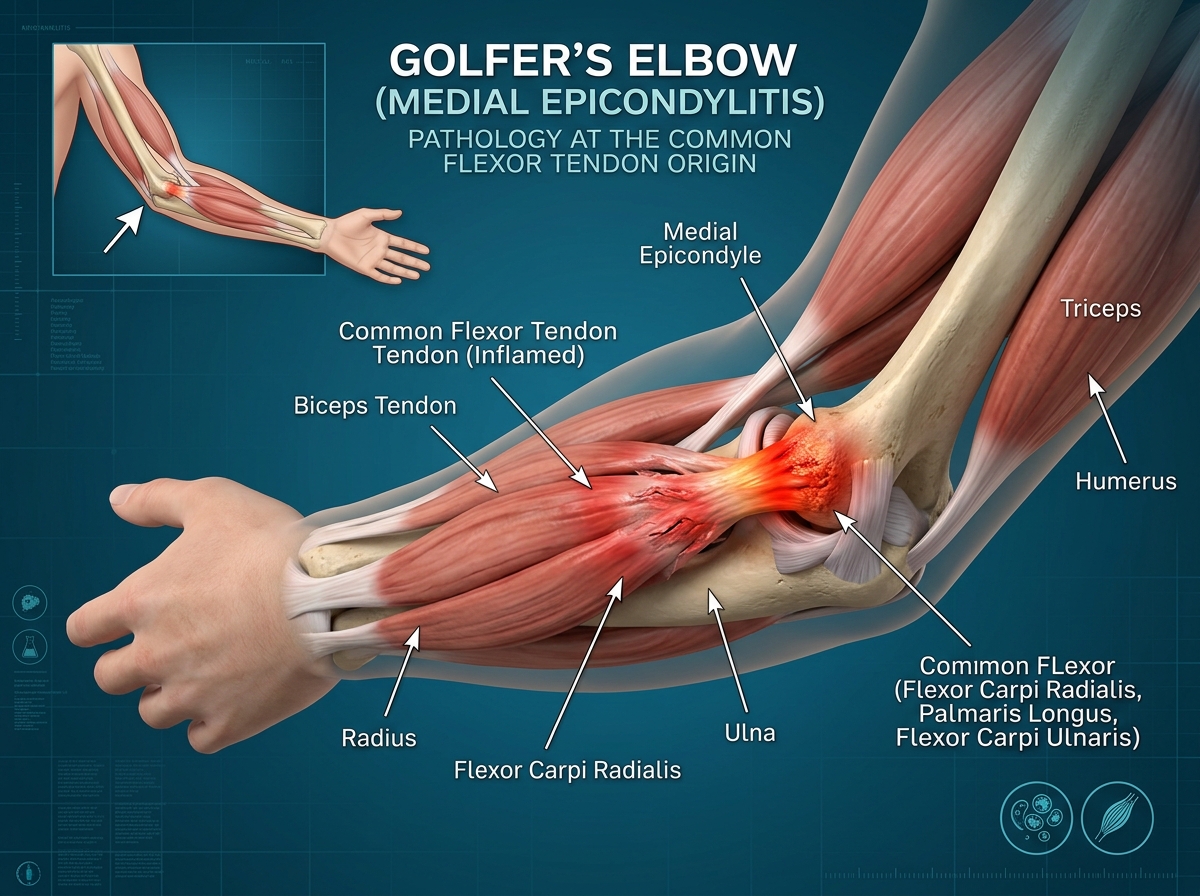
Understanding Golfer's Elbow (Medial Epicondylitis)
Golfer’s elbow is a painful condition characterized by tendinosis and micro-tears in the common flexor tendon origin—most prominently the pronator teres and flexor carpi radialis—where they anchor onto the medial epicondyle (the bony bump on the inner elbow).
Despite its sports namesake, golfer’s elbow affects not just golfers, but also tennis and badminton players (late forehand strokes), javelin throwers, weightlifters, manual tradespeople, and office professionals using non-ergonomic computer setups. Without proper biological care, chronic angiofibroblastic tendinosis can result in recalcitrant tendon degeneration.
Primary Causes & Biomechanical Triggers
- Repetitive wrist flexion and forearm pronation: Repetitive gripping, twisting, or forceful wrist snapping.
- Faulty sports equipment or mechanics: Incorrect golf swing mechanics (hitting the ground first / "fat" shots), overly heavy tennis racket grip size, or excessive tension strings.
- Weight training errors: Heavy wrist curls, heavy pull-ups with improper wrist alignment.
- Occupational overuse: Heavy plumbing, carpentry, typing with sustained wrist extension against hard desk edges.
Symptoms & Clinical Signs
Inner Elbow Tenderness
Point tenderness directly over the medial epicondyle that may radiate down the inside forearm.
Weakness in Grip
Pain when shaking hands, turning doorknobs, picking up a coffee mug, or carrying grocery bags.
Pain on Resisted Wrist Flexion
Sharp spike in inner elbow pain when attempting to bend the wrist downward against resistance.
Elbow Morning Stiffness
Feeling of stiffness and reduced ability to fully straighten the elbow upon waking.
Diagnostic Distinction from Cubital Tunnel
Because the ulnar nerve runs immediately adjacent to the medial epicondyle, approximately 20% of chronic golfer’s elbow cases co-exist with ulnar neuropathy. Dr. Gawai carefully tests for:
- High-Resolution Musculoskeletal Ultrasound (MSK-US): Pinpoints fibrillar discontinuity, hypoechoic collagen tears, and neovascularity.
- MRI of the Elbow: Delineates high-grade partial thickness flexor tears and evaluates medial collateral ligament (UCL) stability.
Treatment Pyramid: Conservative to Surgical
Frequently Asked Questions
Why are steroid (cortisone) injections discouraged for Golfer's Elbow?
While cortisone offers brief temporary relief, clinical studies show it impairs collagen synthesis, increases tendon rupture risks, and causes high long-term recurrence rates. Biologic PRP therapy is far safer and provides lasting structural tissue healing.
How does Golfer's Elbow differ from Tennis Elbow?
Tennis elbow affects the lateral (outer) epicondyle involving wrist extensor tendons. Golfer's elbow affects the medial (inner) epicondyle involving the wrist flexor and pronator tendons.