
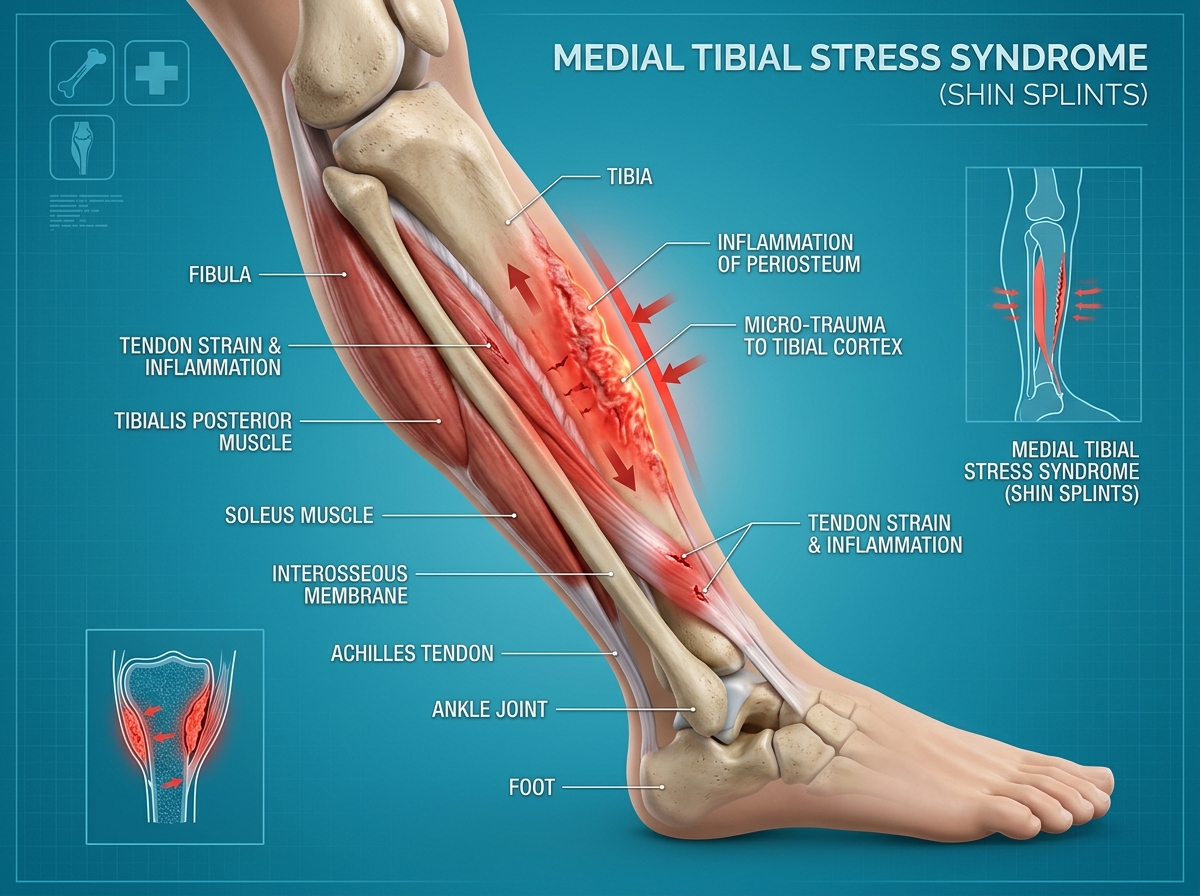
Understanding Shin Splints (MTSS)
Medial Tibial Stress Syndrome (MTSS)—commonly known as "shin splints"—refers to exercise-induced pain along the posteromedial border of the lower leg. It accounts for up to 15% of all running injuries and up to 60% of lower leg pain conditions in athletes, military recruits, and marathoners.
Rather than a localized tear, shin splints represent a continuum of bone strain response and periostitis: repetitive eccentric contraction of the soleus and tibialis posterior muscles places bending strain on the tibial cortex. If ignored, MTSS can progress along the continuum to full-blown tibial cortical stress fractures.
Underlying Biomechanical Causes
- Excessive foot pronation: Hyperpronation causes prolonged eccentric traction on the medial tibial periosteum during push-off.
- Training load errors (The "Terrible Toos"): Too much mileage, too fast, too soon, on excessively hard surfaces.
- Inadequate cadence: Low running step rate (<160 steps/min) leads to excessive overstriding and higher peak tibial shock waves.
- Calf and hip muscle weakness: Weak hip abductors (gluteus medius) allow hip adduction and dynamic knee valgus, overloading the lower shin.
Symptoms & How to Distinguish from a Stress Fracture
Diffuse Tenderness (>5 cm)
Pain is felt along a broad stretch (typically >5 cm) of the inner lower shin bone rather than a focal point.
Early Run Discomfort
Discomfort begins at the start of exercise, may diminish slightly mid-workout, and aches intensely post-run.
Pain on Hopping
Dull ache provoked during repetitive single-leg hopping or impact jumping drills.
Night Aching Warning
If shin pain wakes you up at night or is pinpointed within a 1 cm spot, it strongly indicates a stress fracture.
Diagnostic Imaging & Fredericson MRI Grading
Because plain X-rays are usually normal in early stress injuries, Dr. Gawai utilizes high-field 3T MRI to evaluate the Fredericson stress injury scale:
- Grade 1: Periosteal edema only (true MTSS) – rapid recovery with cross-training.
- Grade 2: Periosteal edema plus bone marrow edema on T2 MRI sequences.
- Grade 3: Marrow edema visible on both T1 and T2 images – pre-fracture state requiring strict protected rest.
- Grade 4: Frank cortical fracture line (tibial stress fracture) – requires complete non-weight-bearing immobilization.
Treatment & Rehabilitation Protocol
Frequently Asked Questions
Can I continue to run through shin splints pain?
Running through sharp or worsening shin pain is strongly discouraged. Continuous bone impact without bone remodeling can convert MTSS into a complete tibial fracture that requires cast immobilization or surgery.
Do compression sleeves actually help shin splints?
Graduated compression socks help dampen muscle oscillation and improve venous return during exercise, providing symptomatic comfort. However, they must be paired with biomechanical retraining for permanent resolution.