
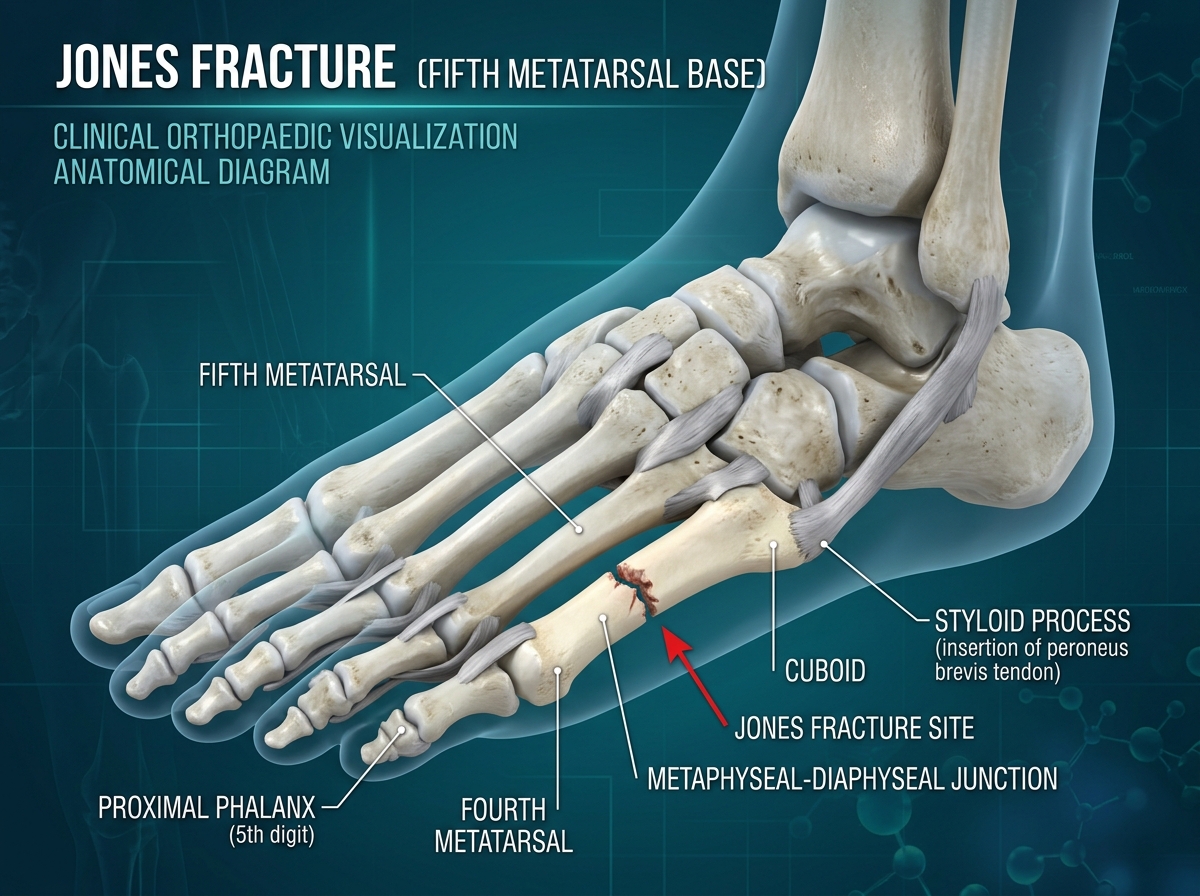
What is a Jones Fracture?
A Jones fracture is a specific fracture occurring at the base of the fifth metatarsal—the long bone on the outside of the foot connecting to the little toe. Specifically, it involves the metaphyseal-diaphyseal junction (classified as Zone 2), approximately 1.5 to 3 centimeters distal to the tuberosity.
Unlike common avulsion fractures (pseudo-Jones fractures) caused by the pull of the peroneus brevis tendon, true Jones fractures occur in a vascular watershed area with notoriously poor retrograde blood supply. Consequently, untreated or cast-immobilized Jones fractures carry high rates of delayed union, non-union (15% to 30%), and recurrent refracture in active individuals.
Lawrence and Botte Metatarsal Classification
- Zone 1 (Tuberosity Avulsion): Involves the tip; excellent blood supply, heals reliably in a supportive boot.
- Zone 2 (True Jones Fracture): Metaphyseal-diaphyseal junction; vulnerable watershed vascularity with high non-union risk.
- Zone 3 (Diaphyseal Stress Fracture): Distal to the intermetatarsal joint, commonly seen as chronic repetitive stress injuries in runners and dancers.
Signs & Symptoms
Lateral Foot Sharp Pain
Localized pinpoint tenderness and throbbing along the outer edge of the foot.
Swelling & Bruising
Rapid localized swelling accompanied by ecchymosis extending toward the small toe.
Antalgic Gait
Inability to bear weight on the outer foot, forcing walking exclusively on the inside heel.
Chronic Prodromal Aching
In stress-type Jones fractures, dull lateral foot pain that existed for weeks prior to acute fracture.
Treatment Strategy: Conservative vs Surgical Fixation
Frequently Asked Questions
Why do athletes almost always choose surgery for a Jones fracture?
Athletes require predictable healing and early rehabilitation. Percutaneous screw fixation cuts non-union risks from ~30% down to under 3%, allowing athletes to return to running within 8 to 12 weeks compared to months of uncertain casting.
Will the screw cause discomfort when wearing football boots or running shoes?
Dr. Gawai utilizes low-profile or headless countersunk cannulated screws that sit flush with the base of the bone, eliminating shoe rubbing or skin irritation.