
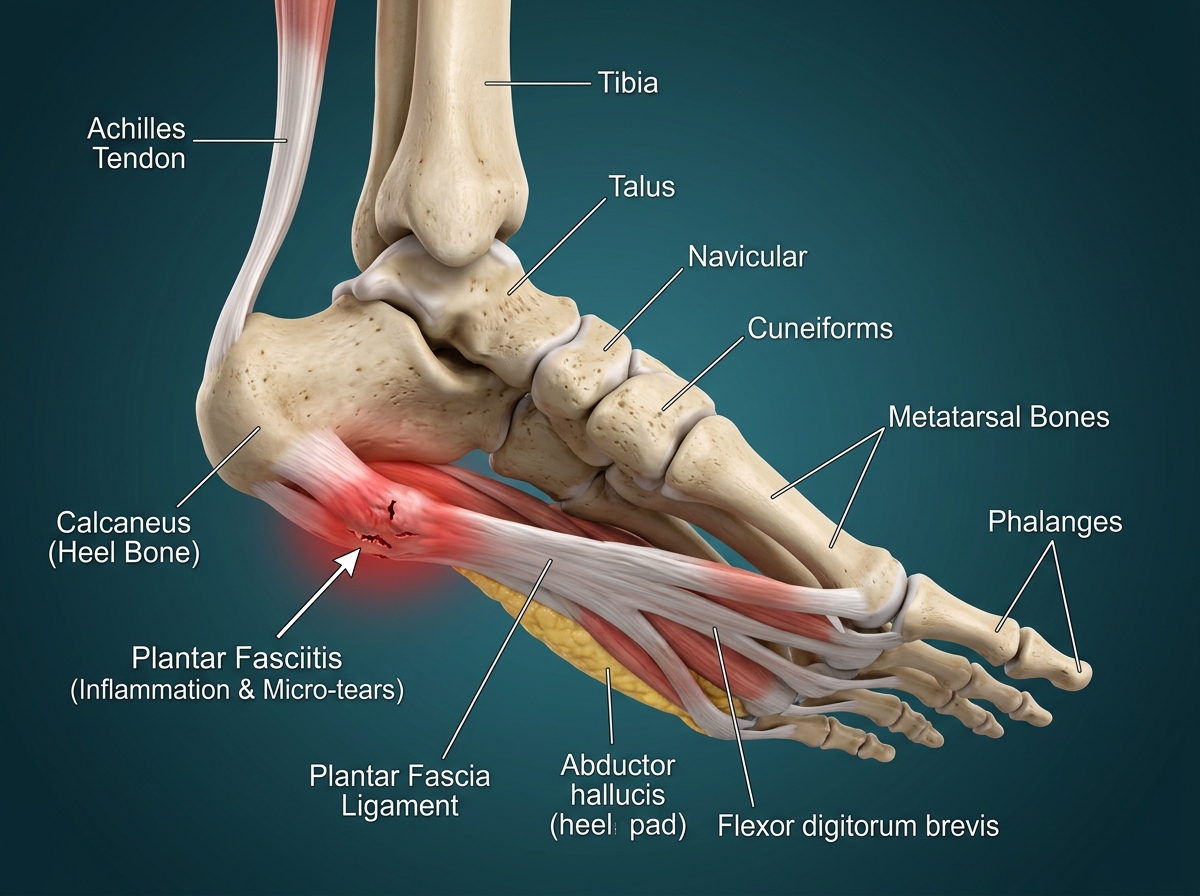
Understanding Plantar Fasciitis
The plantar fascia is a thick, fibrous band of connective tissue running across the bottom of the foot, connecting the heel bone (calcaneus) to the base of the toes. It acts like a shock-absorbing bowstring, maintaining the dynamic arch of the foot during walking, running, and jumping.
Plantar fasciitis is not a simple acute inflammatory condition, but rather a degenerative fasciosis characterized by collagen disorientation, micro-tearing at the calcaneal enthesis, and chronic thickening of the plantar aponeurosis. Over 2 million individuals seek treatment annually for this debilitating condition.
Major Risk Factors
- Foot biomechanics: High arches (pes cavus) or flat feet (pes planus) alter load distribution.
- Tight Achilles tendon: Tight calf musculature prevents dorsiflexion, exponentially elevating tension on the fascia.
- Occupational standing: Prolonged standing or walking on unyielding hard concrete floors (teachers, retail workers, healthcare staff).
- Sudden training mileage spikes: Runners drastically elevating running volume without adequate conditioning.
- Inadequate footwear: Flat shoes without arch support or worn-out athletic trainers.
Classic Symptoms
Agonizing "First-Step" Pain
Stabbing heel pain upon stepping out of bed in the morning or standing up after sitting for long periods.
Temporary Warming-Up
Pain often eases slightly after 10-15 minutes of movement, only to flare up fiercely by evening.
Medial Calcaneal Tenderness
Intense localized tenderness at the inner bottom margin of the heel bone on thumb palpation.
Barefoot Walking Agony
Inability to walk barefoot on hard tile or marble floors without acute pain.
Comprehensive Treatment Pathway
Frequently Asked Questions
Is my heel pain caused by a bone spur?
Heel spurs (calcaneal traction osteophytes) are frequently seen on X-rays, but the spur itself rarely causes pain. Pain stems from degenerative tension in the attached plantar fascia. Removing the spur is seldom necessary.
When is endoscopic plantar fascia release considered?
Surgery is reserved only for the <5% of patients whose symptoms persist beyond 6 to 12 months despite exhaustive conservative and biological treatments. A miniature keyhole release of the medial fascia band produces excellent relief.