
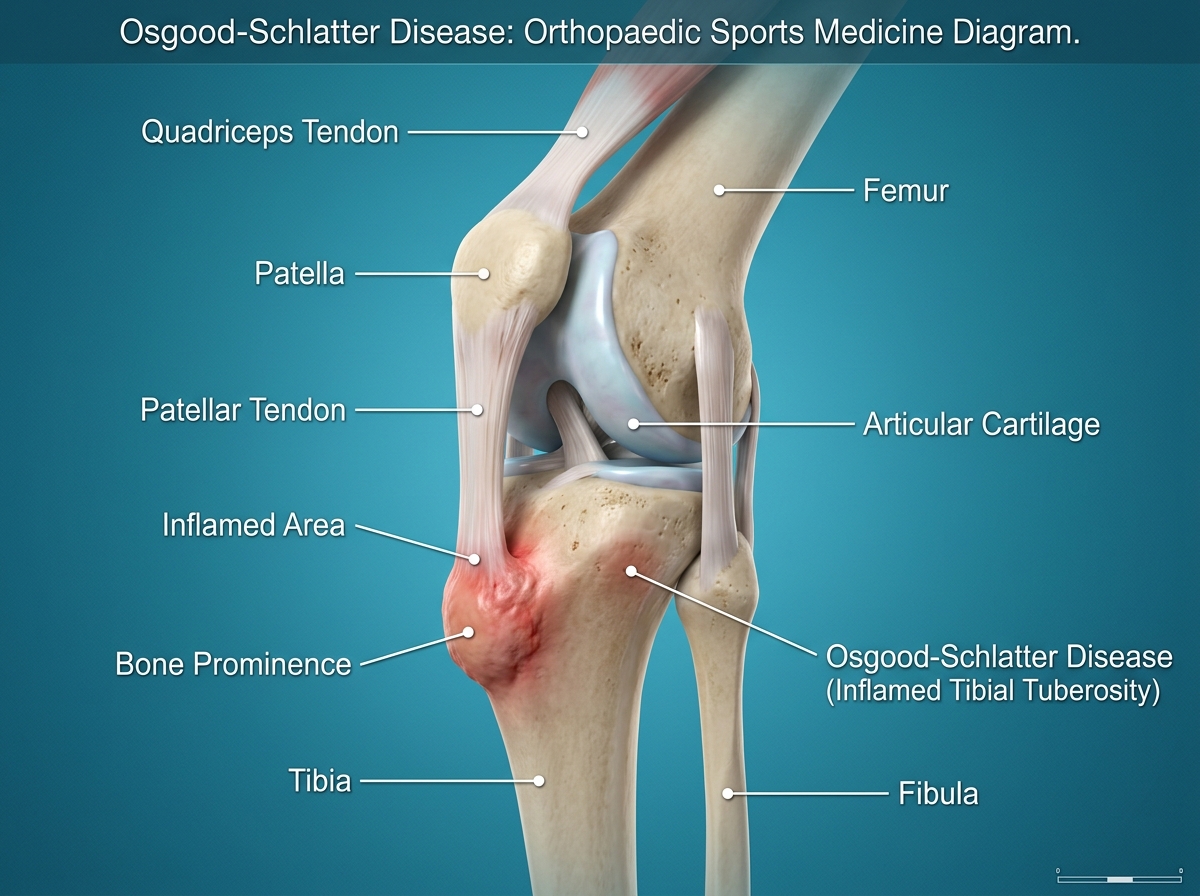
What is Osgood-Schlatter Disease?
Osgood-Schlatter disease (OSD) is a traction apophysitis of the tibial tubercle—the bony prominence right below the kneecap where the patellar tendon attaches. It is one of the most frequent causes of knee pain in active children and adolescents experiencing an adolescent growth spurt (typically girls aged 10–13 and boys aged 12–15).
During periods of rapid bone elongation, the long bones of the leg grow faster than the surrounding quadriceps muscles and tendons can stretch. The resulting excessive, repetitive traction pulled by the powerful quadriceps against an open cartilaginous growth plate (apophysis) leads to micro-avulsion fractures, inflammation, and a tender bony lump below the knee.
Sports Frequently Associated with OSD
- Football / Soccer: High-velocity kicking and rapid sprint changes.
- Basketball & Volleyball: Repetitive jumping, rebounding, and landing impacts.
- Gymnastics & Figure Skating: High impact landing forces.
- Track & Field / Sprinting: Explosive starts placing massive tension across the patellofemoral extensor mechanism.
Characteristic Signs & Symptoms
Prominent Tender Bump
A visible, firm, exquisitely tender swelling directly over the tibial tuberosity below the knee.
Pain on Direct Kneeling
Acute discomfort when kneeling down on hard ground or accidentally bumping the shin bump.
Pain with Squats & Stairs
Sharp exacerbation of pain during deep squats, descending stairs, jumping, or kicking a ball.
Bilateral in ~30%
Approximately one in three active young athletes develops symptoms in both knees simultaneously.
Diagnostic Approach & Growth Plate Safeguarding
Clinical examination by an experienced sports surgeon confirms the diagnosis. Radiographs are selectively ordered to confirm apophyseal ossification staging and rule out other bone conditions:
- Lateral Knee X-Rays: May demonstrate fragmentation of the tibial tubercle or ossicle formation within the distal patellar tendon.
- Rule Out Differential Diagnoses: Crucial to differentiate OSD from Sinding-Larsen-Johansson syndrome (patellar inferior pole apophysitis), patellar tendonitis (jumper’s knee), or bone tumors (osteosarcoma).
Treatment & Athletic Management
Frequently Asked Questions
Will the bump below my child's knee go away permanently?
While pain completely resolves once skeletal maturity is reached and the growth plate fuses (around age 16-17), the bony prominence itself usually remains permanently. It is completely benign and does not affect adult sports ability or joint health.
Is surgery ever needed for Osgood-Schlatter?
Surgery is strictly contraindicated in growing children because operating on an open growth plate can cause premature fusion and recurvatum deformity. In rare cases where a painful ununited ossicle persists in adulthood after growth is finished, simple ossicle excision cures the issue.